Showing posts with label auroral-e. Show all posts

Tuesday, January 20, 2026

DL0IGI 10m beacon in Germany heard via Auroral-E - 19th Jan 2026


On the 19th of January 2026, I noticed some posts on social media saying that the Northern Lights / Aurora Borealis was visible. Sure enough, I went outside to check and I could see the sky to the north was a red colour.

I went inside and tuned across the 28 MHz (10m) band and noticed that a few beacons were audible.


I was expecting to hear some distorted auroral signals but instead, the CW signals were clear, a sure sign of Auroral-E.

Most of the beacons were from Norway, Sweden and Finland but the one that caught my attention was DL0IGI on 28.205 MHz. This beacon is about 1500kms from my location and I presume the path was like the one shown above with the signal coming back off the auroral curtain.

The screengrab below is the audio spectrum of DL0IGI over a period of about 8-minutes.


I often hear this beacon via Sporadic-E during the summer months and on a display like the one shown above, it should be pretty much a straight horizontal line.

During the aurora, the signal seems to be refracted off a rapidly moving auroral curtain resulting in quite a bit of doppler on the signal. In the diagram above, the signal is jumping around by about +/- 20 Hz but sometimes, it went as far as +/- 60 Hz.

All of this jumping around gave the Auroral-E signal a distinctive quality. The 'mush' and spreading of the CW signal is not present yet there is still something strange sounding about the signal. The constant jumping around gives the CW tone a slightly hollow sound.

I checked the LA5TEN beacon near Oslo and this also had some doppler on it but a lot less. It was the same for the other beacons from Sweden and Finland.

I didn't spend too long on the band other than to listen for a while to a station on the Faroe Islands working a pile up of European stations on SSB. His audio sounded clear but again, it had a slightly hollow sound to it.

None of the signals heard were exactly rare DX but it was interesting all the same to catch this unusual opening.

Tuesday, January 18, 2022

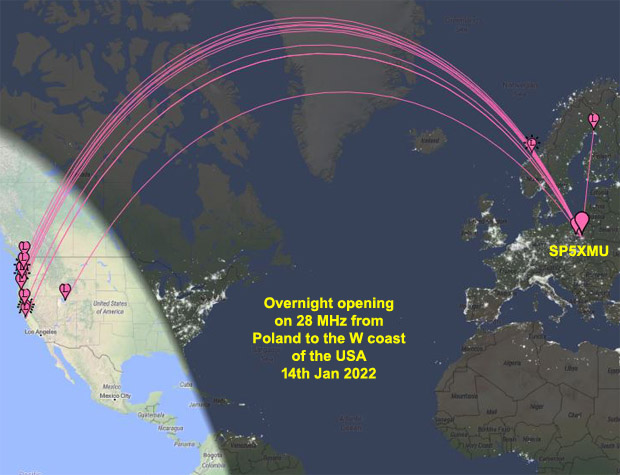
Overnight opening on 28 MHz from Europe to the W coast of the USA - 14th Jan 2022


At present, nearly all of the openings on the 28 MHz band are during the daylight hours. The solar flux is roughly around the 100-120 mark and there are some F2 layer openings during daylight hours. There is also some mid-Winter Sporadic-E at times but again, this is during daylight hours.

14th January 2022: At about 22:30 to 22:45 UTC, Tom SP5XMU in Poland was one of those who caught an opening to the west coast of the USA on the 28 MHz band. For Tom, this would have been around 11:30 PM.

This is highly unusual and worth noting. It's about 7 hours after the sun has set in Poland so it can't be easily explained the position of the sun and it is also a very northerly path.

At the bottom of this post, I have the FT8 log for SP5XMU for this opening and it shows that there was an opening to Scandinavia at the same time from Poland.

Tom wasn't the only person to catch this opening. Further down this post, I have a list of spots from European stations of US stations on 28 MHz. It suggests that the main opening lasted from about 19:30 to 23:15 UTC.

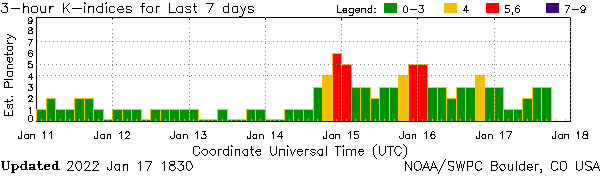
Auroral-E: It is probably no accident that this opening from Poland to the USA coincided with an aurora and a high k-index of 5-6.


It wasn't the typical 'aurora' where signals are spread out and distorted. After all, digital FT8 signals were being decoded. Instead, it was likely to have been auroral-e propagation.

Distance: However, the distance from SP5XMU to the stations on the west coast of the USA was in the region of 9,000kms.  Aurora-E as the name suggests forms in the E layer of the ionosphere and the maximum range from one hop would be in the range of 2000-2300 kms.

That leaves a huge gap of about 7000kms in the path to the USA. 

How did the signal get from Europe to the west coast of the USA? 
Multi-hop auroral-E? 
Some form of chordal hop auroral-E? 
Did it couple into some ordinary Sporadic-E or F2 layer at the western end of the path?

I've seen a lot of people just explain it away as 'Auroral-E' but it's more complex than that. That's what makes this type of opening so interesting.

50 MHz: I checked the DX cluster and I could see no spots for an opening from North America to Europe on that band.

DX-Cluster spots for European stations spotting the USA on the 28 MHz band...