Radio amateurs have been sending and receiving TV signals for a number of decades. First it was analogue TV and that became digital TV in more recent years.
With the advent of digital TV or digital amateur TV (DATV) to give it its full title, radio amateurs have been resourceful in squeezing video signals in smaller and smaller bandwidths. This has resulted in signals being several hundred kHz wide instead of several MHz.
During tests on 29.400 MHz in November of 2025, Stavros SV1EBS in Athens, Greece managed to receive the DATV signals from Frans, ON4VVV in Belgium, a distance of about 2124 kms.
The path which was most likely via a single F2 layer hop off the ionosphere was the first reception of a DATV signal from Belgium in Greece.
The image above contains some screenshots of the signal from ON4VVV. The image below is a screenshot from the YouTube video from SV1EBS. It shows the MiniToune software and I have highlighted the received signal from ON4VVV in red.

Technical details... For this experiment, ON4VVV was using a homemade Portsdown TX with a mini Lime SDR and a Rasberry Pi to generate the D-ATV signals. The format used was DVB-S2 with a symbol rate of 125 kilo-symbols per second (125 kS/s) with Forward Error Correction (FEC) of a ½. The data rate was 250 kilobits/sec.
The D-ATV signal bandwidth on 29.4 MHz was about 150 kHz and Frans was running 400-watts from a homemade power amplifier to a 4-element mono-band beam at 19 metres above ground level.
On the receive side, SV1EBS in Athens was using a simple dipole for 10m with an upconverter in front of his “minitiouner”. It's worth noting that this basic set up resulted in a successful reception of the D-ATV signals. There is plenty of scope for improvements with the addition of a directional beam with gain, a pre-amplifier and a bandpass filter.
Frans, ON4VVV writes... "This signal was demodulated by the minitiouner into a colour picture with strength indicator between D1 and D4. This means that he had between 1 and 4 dB of spare power in RX.
A second test was done with DVB-S2 and symbol rate of 250 kS/s and this was demodulated into a picture for only a short time."
The video clip below is from SV1EBS which shows reception of the D-ATV signal on the 9th of November 2025. Note that the test card that is being received is video and not a single static image.
Second test on the 16th of November... One week later, some more tests were carried out and the signals were even stronger.
Fran writes... "Exactly one week later we did the same test in DVB-S2 with SR 125ks and FEC ½ because maybe we had been simply lucky that first time. Again SV1EBS could demodulate my signal but this time up to D8 meaning a real strong signal with up to 8dB spare RX signal
We decided to switch over to SR 250ks with my camera connected and again it produced a picture , but this time a moving picture from my camera. Both connections have been demodulated during tens of minutes."
A video of the second test can be seen below...
Analysis... While this may seem at first to be just the reception of a low resolution video, it's a significant achievement.
First, there is the challenge of reducing the bandwidth of a video signal from MHz to just 150 kHz and the guys in the ATV community have been doing this successfully. The second part is the challenge of trying to receive a D-ATV signal off the ionosphere.
When you listen to someone on a narrow band mode like SSB, you can hear the audio and the signal strength changes over time i.e. there's fading. This is often due to the signal arriving in phase and out of phase as it comes back down off different parts of the ionosphere. In other words, the path length is changing.
When you look at a D-ATV signal coming from someone a few kms away, you'd see a nice clean signal on the waterfall display. When the D-ATV signals comes down off the ionosphere, it looks something like this...

The dark diagonal streaks are where the signal is being cancelled out. It starts at the higher frequency and as the conditions change over time, the 'notch' moves lower in frequency as the longer wavelength signals cancel out.
As you might imagine, losing big chunks of the digital video signal plays havoc with reception.
Future tests... ON4VVV is looking trying for a trans-Atlantic reception report. Frans writes... "I am sure that transmitting D-ATV from EU to USA must be possible and demodulated into a moving picture too, but all my efforts to find somebody over there with a decent antenna to receive me was in vain."
Anyone in the USA or Canada interested now that we're still near the peak of the sunspot cycle and conditions on 10m are still good?
Links...
1) Previous report about a successful DATV test on 29 MHz across the North Atlantic - 7th Nov 2022
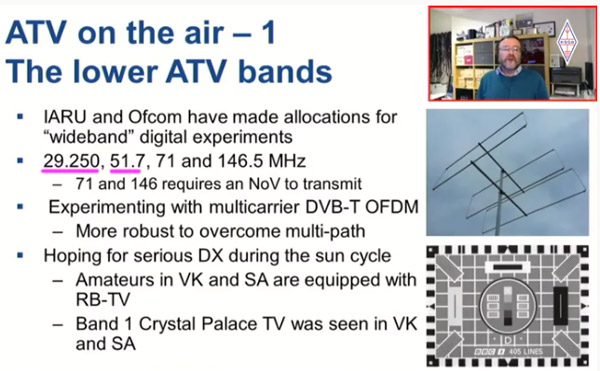
2) More information about the proposed Amateur TV experiments at 29.250 MHz & 51.7 MHz